

This post may contain affiliate links. As an Amazon Affiliate, I may earn a small commission from qualifying purchases at no extra cost to you. Read the full disclaimer here.
Conn Iggulden writes dramatic, action packed historical fiction, and he covers a huge amount of ground within his works. From ancient Rome to the Mongol conquests to the Persian Wars in Ancient Greece, and even the Wars of the Roses in medieval England.
Unlike an author like Kate Quinn or Ken Follett whose works span generations and sometimes jump backwards and forwards in time, Iggulden’s series are sequential, telling a single continuous story following a primary protagonist across multiple books. What this means is if you get invested in the characters in book one of a series, you can follow them all the way to the end. But it also means you should always start on book one in a series.
With around 40 titles to his name now, where should you start? And what order should you read Iggulden’s books in?
If you’re building out your historical fiction shelf more broadly, our guides to the best historical fiction books and 11 of the best historical fiction authors are good places to start too.
Where to Start With Conn Iggulden
If you only read one series, make it Conqueror. The five books take you from a starving exiled boy on the Mongolian steppe to the founding of the largest land empire in history. Big battles and brutal tribal politics.
If you’d rather ease in somewhere more familiar, Emperor is the better choice. It’s his debut series, it covers Julius Caesar, and the five books are a little more straightforward in structure than Conqueror’s shifting cast of khans and generals.
If you want a shorter commitment than a full five books, I can recommend the Athenian duology (The Gates of Athens and Protector). It’s only two books, covers Marathon and Thermopylae, and reads faster than his longer series.
A Breakdown of Conn Iggulden’s Best Series
The Emperor Series (Ancient Rome)
Iggulden's debut series, and still probably his most famous: a five-book account of Julius Caesar's life, from childhood to assassination and its bloody aftermath.
The Gates of Rome (2003) — young Caesar and his friend Marcus grow up on a Roman estate, train under a brutal ex-gladiator, and get swept into the power struggle between Marius and Sulla.
The Death of Kings (2004) — Caesar, forced to flee Rome, serves in the navy and survives capture by pirates.
The Field of Swords (2005) — Caesar builds his power base and marches into Gaul, even as enemies plot against him back home.
The Gods of War (2006) — civil war between Caesar and Pompey, culminating in Caesar's inexorable rise.
The Blood of Gods (2013) — Caesar's assassination and the bloody revenge that follows, as Octavian and Mark Antony hunt down the conspirators.
Start here if ancient Rome is your primary interest, and for more of the era, see our guide to the best historical fiction books, which places Iggulden alongside Robert Harris, Colleen McCullough, and Kate Quinn.

The Conqueror Series (Genghis Khan and the Mongol Empire)
This one is my favourite series of Iggulden's. This ambitious five book series traces the rise of Genghis Khan from an exiled, starving boy on the Mongolian steppe to the founder of history's largest contiguous land empire. It humanises the conqueror, explores the culture and history of the tribes, and for those interested, the military tactics that allowed the Mongolians to take over the known world.
Wolf of the Plains (2007) — published in the US as Genghis: Birth of an Empire. Temujin, exiled from his tribe as a child, begins the long climb toward becoming Genghis Khan.
Lords of the Bow (2008) — the tribes united, Genghis turns his armies toward the fortified cities of the Chin empire.
Bones of the Hills (2008) — Genghis pushes west into unknown territory, even as rivalry between his sons begins to fracture the family.
Empire of Silver (2010) — after Genghis's death, his son Ogedai works to hold the empire together and complete the building of Karakorum.
Conqueror (2011) — Kublai Khan's rise, and the beginning of an empire stretching further than even his grandfather's.
It's a slightly different flavour of Iggulden. A tough land and tougher people. Brilliantly researched, immensely imaginative, it places you on the steppes, an unfamiliar, alien landscape, and makes the rise of the Mongols and of Genghis Khan appear inevitable.

The Athenian Series and The Golden Age (Ancient Greece)
A more recent, shorter pair of duologies set during and after the Greco-Persian Wars. This is a piece of history I've been fascinated by ever since I was a teen, my first exposure coming from David Gemmell's Lion of Macedon.
Iggulden takes a closer look at the turning points of Ancient Greek history, the moments and battles that took Greece out from under the Persian yoke and made it the military and cultural powerhouse that would go on to shape all of western civilisation: Marathon, Thermopylae, and the rise of Athens under Pericles.
Athenian series:
The Gates of Athens (2021)
Protector (2022)
The Golden Age (a generation later, following Pericles):
Lion (2022)
Empire (2023)
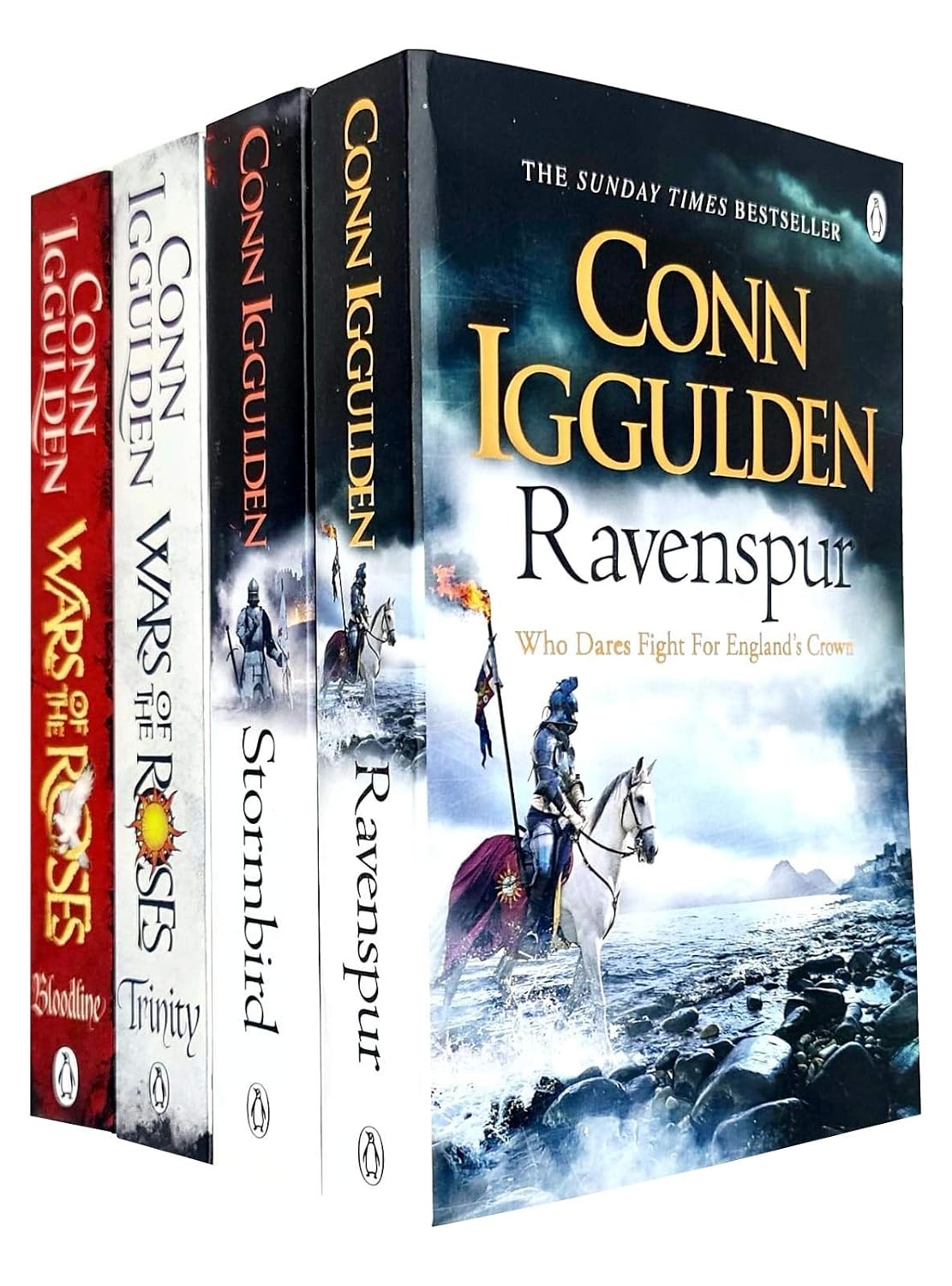
The Wars of the Roses Series (Medieval England)
I have always found the Wars of the Roses a little dull. I think largely because of how it was taught in school, it's all underhand deals and politicking and dates, and every third character is called either Richard or Henry or Oliver, which frankly gets confusing.
However, Iggulden's approach to the intrigue and conflict of English history is anything but dull. A four-book account of the decades-long dynastic conflict between the houses of Lancaster and York. You can see how it might have inspired much of the political manoeuvring in Game of Thrones.
Stormbird (2013) — the death of Henry V leaves England in the hands of his frail son, and Richard of York begins to move against a weakening throne.
Trinity (2014) — also published as Margaret of Anjou. The conflict widens as Margaret, Henry VI's fierce queen, takes an increasingly active role in the fight to hold the throne for her family.
Bloodline (2015) — the war deepens, alliances shift, and the body count climbs on both sides.
Ravenspur: Rise of the Tudors (2016) — the series closer, ending with the rise of the Tudor dynasty that would eventually produce Henry VIII.
There's also a related standalone, Dunstan (2017), which follows the Anglo-Saxon Archbishop who helped shape the England that the Wars of the Roses would later tear apart. A good companion read if you want more of the same period's political texture.

The Nero Trilogy (Back in Ancient Rome)
Iggulden's most recent major project returns to ancient Rome, this time focused on the emperor Nero, his reign, the growing unrest in Britain under Boadicea and in Gaul under Vindex, and the unravelling of his rule.
Where the Emperor series builds Caesar into a figure worth admiring even at his most ruthless, Nero runs the opposite direction. He starts out as a boy who wants to be a good and noble Roman, and then over the trilogy we watch how power strips that nobility away from him.
Nero (2024) — Agrippina schemes to secure the throne for her son Lucius through marriage to the Emperor Claudius. This one covers his boyhood through to his coronation as emperor.
Tyrant (2025) — Nero fends off rivals at court and begins to settle into the role of the most feared ruler in Roman history. His mother Agrippina, his first wife Octavia, and eventually his second wife Poppaea are all removed, one by one, as Nero consolidates absolute power.
Inferno (2026) — the closing volume. By AD 60, Nero's spending on monuments to himself has emptied the treasury, and his cruelty has bred enemies on every side. Boadicea revolts in Britain, the Gauls rise under Vindex, and Rome itself, his own city, becomes the site of his undoing.
Other Books by Conn Iggulden
Outside his major series, Iggulden has written a handful of standalone historical novels, a full fantasy trilogy under a slightly different name, and the nonfiction book that made him a household name before most of his historical fiction was even published.
Standalone Historical Novels

Dunstan (2017), published in the US as The Abbot's Tale — set in tenth century England, following Dunstan of Glastonbury, the priest and advisor who helped steer seven kings toward the unification of England under Athelstan. It works well as a companion piece to Wars of the Roses, since it covers the earlier history of the England that series later tears apart.

The Falcon of Sparta (2018) — a return to the ancient world, retelling the march of the Ten Thousand, a Greek mercenary army stranded deep in Persian territory after the death of the prince they were fighting for. Standalone, and a good entry point if you want a single book rather than a series commitment.
The Empire of Salt Trilogy (Writing as C.F. Iggulden)

Iggulden's one full step into fantasy, published under a slightly altered version of his name. Set entirely in an invented world rather than a historical one, it follows Tellius, a former thief turned teacher, as the city of Darien is threatened first from within and then by an invading empire of swordsmen from Shiang.
Darien (2017)
Shiang (2018)
The Sword Saint (2019)
Reader opinion on this one is more divided than on his historical fiction. Darien is generally well liked, but reception cools a little across Shiang and The Sword Saint. Worth trying if you already know you enjoy his prose and want to see it applied outside a historical framework. If secondary-world fantasy is more your speed generally, our guide to the best fantasy books is a good next stop.
Nonfiction: The Dangerous Book for Boys
Co-written with his brother Hal, The Dangerous Book for Boys (2006) is a guide to roughly eighty activities, from tying knots to growing crystals to building a soapbox racer. It made Iggulden the first author to top both the UK fiction and nonfiction bestseller charts at the same time, and it spun off a small library of yearbooks, pocket guides and kits. It’s a different kind of book entirely from anything else on this list, but worth knowing about if the name is only familiar to you from that shelf.
Conn Iggulden Reading Order: Every Book, Ranked Start to Finish
Because his series are sequential, the table below groups books by series and keeps each series in its correct internal order.
Where you start depends on the interest described above. However, if you’re the kind of reader who likes to leave no page unturned, this is the order I’d suggest:
| Order # | Title | Series | Setting | Goodreads Rating |
|---|---|---|---|---|
| 1 | The Gates of Rome | Emperor #1 | Ancient Rome | 4.20 |
| 2 | The Death of Kings | Emperor #2 | Ancient Rome | 4.30 |
| 3 | The Field of Swords | Emperor #3 | Ancient Rome | 4.31 |
| 4 | The Gods of War | Emperor #4 | Ancient Rome | 4.33 |
| 5 | The Blood of Gods | Emperor #5 | Ancient Rome | 3.93 |
| 6 | Wolf of the Plains | Conqueror #1 | Mongolia | 4.39 |
| 7 | Lords of the Bow | Conqueror #2 | Mongol Empire / China | 4.37 |
| 8 | Bones of the Hills | Conqueror #3 | Central Asia | 4.38 |
| 9 | Empire of Silver | Conqueror #4 | Mongol Empire | 4.34 |
| 10 | Conqueror | Conqueror #5 | Mongol Empire / China | 4.46 |
| 11 | Nero | Nero Trilogy #1 | Ancient Rome | 4.19 |
| 12 | Tyrant | Nero Trilogy #2 | Ancient Rome | 4.39 |
| 13 | Inferno | Nero Trilogy #3 | Ancient Rome | 4.39 |
| 14 | Stormbird | Wars of the Roses #1 | Medieval England | 3.93 |
| 15 | Trinity | Wars of the Roses #2 | Medieval England | 4.16 |
| 16 | Bloodline | Wars of the Roses #3 | Medieval England | 4.27 |
| 17 | Ravenspur: Rise of the Tudors | Wars of the Roses #4 | Medieval England | 4.25 |
| 18 | Dunstan | Standalone | Anglo-Saxon England | 4.05 |
| 19 | The Gates of Athens | Athenian #1 | Ancient Greece | 4.26 |
| 20 | Protector | Athenian #2 | Ancient Greece | 4.38 |
| 21 | Lion | The Golden Age #1 | Ancient Greece | 4.13 |
| 22 | Empire | The Golden Age #2 | Ancient Greece | 4.34 |
| 23 | The Falcon of Sparta | Standalone | Ancient Greece / Persia | 4.15 |
| 24 | Darien | Empire of Salt #1 | Fantasy (secondary world) | 3.88 |
| 25 | Shiang | Empire of Salt #2 | Fantasy (secondary world) | 4.08 |
| 26 | The Sword Saint | Empire of Salt #3 | Fantasy (secondary world) | 4.23 |
Goodreads ratings correct as of 2026 and may shift over time.
Want to track your progress through all 26? You can log each one and see what other historical fiction fans are reading on Litloop’s historical fiction hub.
Final Words: Conn Iggulden Reading Order
Twenty six books is a lot to look at in one go, but the good news is you can tackle Iggulden in chunks. Each series stands on its own, so you can read Conqueror this year and come back for Wars of the Roses whenever you’re in the mood for it.
If you take one thing away from this guide, let it be this: start with whichever era already interests you, read that series in order, and let it decide whether you want more. Given how consistently his books rate across four different centuries and two different continents, there’s a good chance you’ll love his work as much as I do.
You Might Also Like
- The Best Historical Fiction Books
- 11 of the Best Historical Fiction Authors You Must Read
- Fan Guide to the Best David Gemmell Books
- The Ancient Stories: 14 of the Best Books About Greek Mythology
Track your progress through Conn Iggulden’s novels, and find your next read, on Litloop, the free reading tracker for fiction fans.

Love books? You'll love Litloop.
Track your reading, send personal recs, and have real conversations about the books you love.
Create free accountFree forever · Beta now live · iOS & Android apps coming soon