
This post may contain affiliate links. As an Amazon Affiliate, I may earn a small commission from qualifying purchases at no extra cost to you. Read the full disclaimer here.
Over thirty novels, David Gemmell built worlds soaked in blood and honour and grief, and populated them with warriors who were flawed, frightened, often broken — but who chose, at the decisive moment, to stand firm for what they believed in. That choice, and what it costs, is what every Gemmell novel is really about.
His books don’t require a reading order, and you can walk into almost any of them cold and be gripped within ten pages. But some are extraordinary, and some are merely excellent. This is our guide to the best of him.
If you’re after something in a similar vein once you’re through, our guides to grimdark fantasy and the best epic fantasy are good next stops.
Where to Start With David Gemmell: A Note
If you’re new to Gemmell, Legend is the traditional entry point. It’s his debut, his most famous, and in many ways his most personal. In my view it’s not necessarily his best (definitely top 10) — it’s more the beginning of a conversation he spent the rest of his career completing.
If you want to understand where he came from and plan to read through the whole collection, this is a great starting point, but it’s not the only one.
Read next: our Drenai series reading order guide.
The Books

1. Lion of Macedon (1990)
For a long time, this was my favourite Gemmell novel, and for many readers it still is.
Set in ancient Greece, Lion of Macedon is about as close as Gemmell ever came to straight historical fiction (though he tried again later in his career with his Troy series), and the result is something genuinely special. The world feels real in a way his pure fantasy settings sometimes don't. You get the Spartan agoge, the blood rivalry between Athens and Sparta, the shadow of Thermopylae, the texture of a civilisation in its complicated, contradictory prime. Well-researched without ever turning academic — the history carries weight, and I genuinely became a little obsessed with ancient Greece after reading this novel.
At the centre is Parmenion, only half-Spartan and hated for his Macedonian blood. He's not a Chosen One, and he's not destined to save the world. According to the seer Tamis who watches over him, he is in fact destined to destroy it. The dark god is coming, and Parmenion is the door it walks through.
Tamis spends the novel trying to weaken him, to blunt his potential, to keep him from becoming the instrument she fears. In doing so she forges him anyway. His hardships, his defeats, his losses are what make him into the very man she was trying to prevent. It's a tragedy with the shape of an adventure. Parmenion becomes great not because fate ordained it, but because every attempt to stop him gave him someone to fight, something to prove, a reason not to break.
The battle sequences are superb, the characterisation among the best Gemmell ever produced. And the ending opens into Dark Prince, the sequel that takes the story into genuinely strange, mythological territory. Start here. Come back to the Drenai after.
Connect with: Dark Prince (direct sequel, though definitely weaker than book one), and the Troy trilogy (later Gemmell Greek-world writing — if that period of history grips you, see also our guide to the best books about Greek mythology).

2. Echoes of the Great Song (1997)
A standalone novel with no series baggage, Echoes of the Great Song is set in a dying civilisation loosely inspired by Atlantis. Long ago the Avatars discovered how to harness sunlight and use that power to make themselves effectively immortal. They ruled for centuries, assured of their near godhood.
Then the world shifts on its axis (a recurring theme in Gemmell's books — see the Jon Shannow books below), the oceans rise, and their great civilisation is destroyed. The surviving Avatars desperately cling to power, to immortality, becoming parasites and monsters.
The book has everything you'd expect from Gemmell: the impossible last charge, the psychopathic general finding his way back to something human, a love story with more weight than it has any right to, the quiet heroism of ordinary people in extraordinary circumstances.
But it's also doing something more ambitious, interrogating what happens when privilege becomes structural, when a whole civilisation builds its survival on the suffering of others, and what it takes to dismantle that. Fans of politically-charged standalone fantasy novels should make this a priority.
3. Legend (1984)
In 1976, Gemmell was a young journalist facing what he believed was a cancer diagnosis. To take his mind off it, he started writing a novel about a fortress under siege. The fortress was his body. The attacking horde was the cancer.
You can feel all of that in the pages. Legend is a book written by someone who genuinely didn't expect to live. It's raw, urgent, a little rough, full of a desperate emotional honesty that more technically accomplished novels rarely achieve. Druss the Legend is the great hero of the Drenai, the axe-wielding warrior everyone tells stories about. The fortress of Dros Delnoch is the last thing standing between the Drenai empire and half a million invaders. Druss is old, in pain, and has come to stand with this lost cause — he has come to die the way he has lived, with his mighty axe, Snaga, in hand.
The other hero, Rek, is young, sarcastic, and utterly terrified. Gemmell wrote him as a deliberate counterargument to the genre and as a sort of foil to the indomitable, battle-weary Druss. Rek is a rogue who bluffs his way into being the hero of the story. He's a cheat, a womaniser, he's useless with a sword, and has no great moral code. But over the book he becomes the man he started off performing. He is courageous because of his fear, heroic because of his lack of heroism. That idea — that courage is not an absence of fear but the decisions made despite it — runs through every Gemmell book that followed.
Connect with: Waylander (another of the Drenai novels — see below), and The First Chronicles of Druss the Legend (Druss's origin story).

4. Waylander (1986)
The best argument that Gemmell improved quickly.
The king is dead. The nation is falling into ruin and war — the invasion Druss dies to prevent is enabled by this act. And only one man can save the day: Waylander. The problem is, Waylander the Slayer is the very same assassin who killed the king.
Tighter than Legend, faster, meaner, with a protagonist who starts in a more genuinely damaged place. The question the novel asks is whether a person so morally compromised, so flawed, can be redeemed, and Gemmell, typically, refuses to make the answer easy.
Action, chase scenes, and a redemption arc all serve to deepen the moral architecture — how guilt and responsibility and the possibility of change interact.
Connect with: Waylander II: In the Realm of the Wolf and Hero in the Shadows, for the complete Waylander trilogy.

5. White Wolf (2003)
White Wolf might technically be Gemmell's best work. It introduces Skilgannon the Damned, a warrior haunted by war, by the orders he's given and the blood on his hands. Like Waylander, it's a story of redemption.
And we get to see Druss again, in one of the most satisfying double-act structures Gemmell ever built. The two men circle each other: Druss rigid and uncomplicated in his moral code, Skilgannon brilliant and tortured and searching for meaning.
The novel examines something Gemmell revisits across many of his novels: the hypocrisy of honour in war, morality in violence, goodness in bloodshed. The code of Druss takes centre stage, rigid and uncompromising — a simple black-and-white answer to a world of moral greys. Skilgannon lives in those greys, in the moral ambiguity, always questioning right from wrong.
Gemmell had grown significantly as a writer by the time he tackled this novel. The prose is sharper, the structure tighter, the emotional beats more precisely placed. White Wolf is evidence of what he'd become.
Connect with: The Swords of Night and Day — Skilgannon continues centuries in the future. Again, not as good as book one, but if you want more of the characters it scratches that itch.
—
6. Wolf in Shadow (1987)
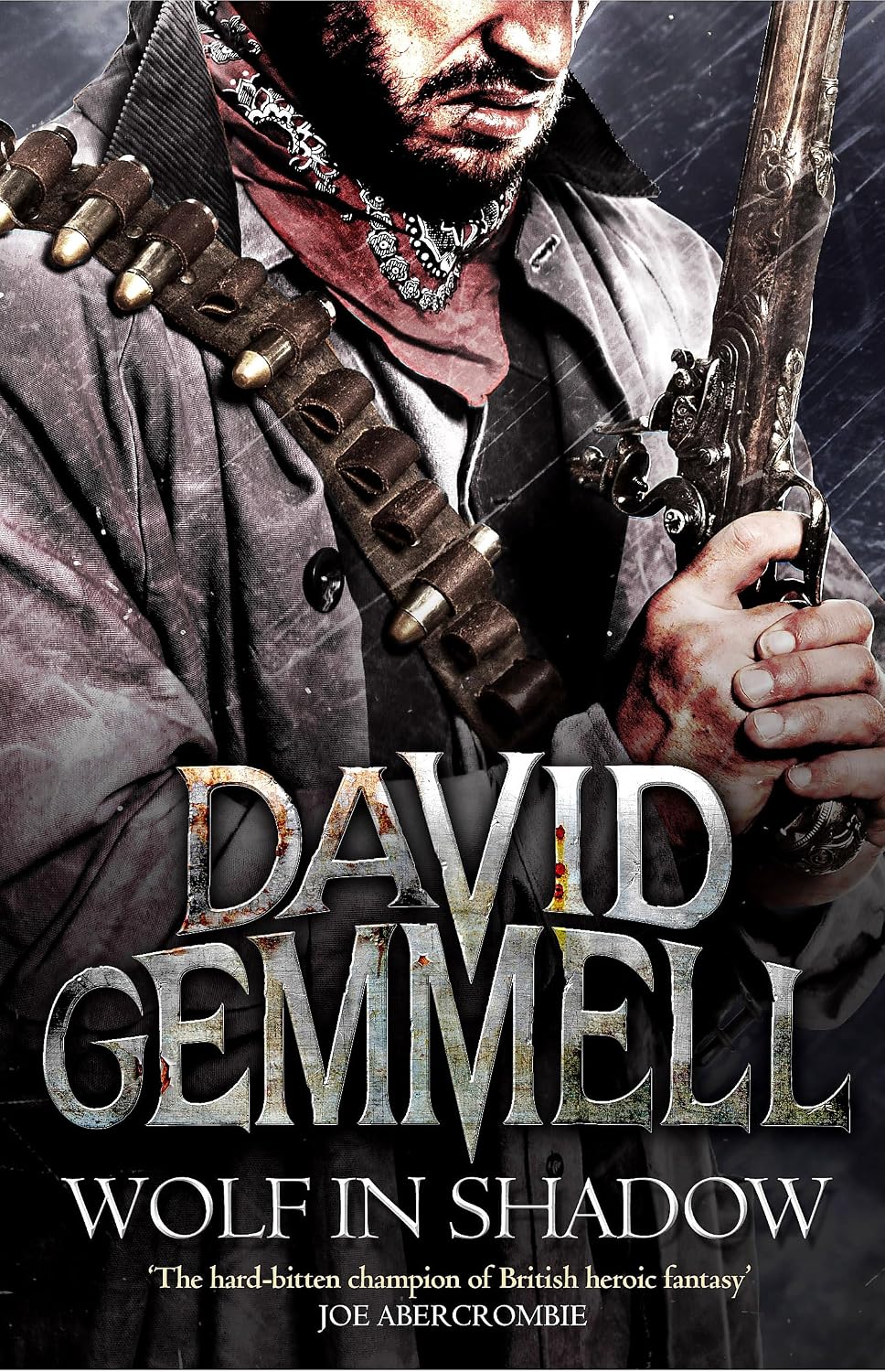
The first Jon Shannow book. A post-apocalyptic western. The world has tilted on its axis, the sea has flooded the land, and civilisation as we know it has collapsed into a brutal, quasi-biblical wasteland. Jon Shannow, the Jerusalem Man, is a gunslinger searching for the holy city, leaving a trail of violence in his wake and trying to reconcile his faith with the violent man he has become.
The Sipstrassi stones are the core magical element, a recurring system appearing here as artefacts of the old world that tie it into his wider mythology, in books like Lion of Macedon. Shannow himself is one of Gemmell's best characters — relentless, honourable, and internally conflicted. A man who hates violence but is just so good at it.
Wolf in Shadow was also written while Gemmell was dealing with his mother's terminal cancer diagnosis. That grief is in the book: the sense of a world coming apart, of something irreversible approaching, of a person trying to keep moving because stopping means feeling it.
Connect with: The Last Guardian and Bloodstone, to complete the Jon Shannow trilogy.
—

7. Ravenheart (2001)
The Rigante series is set in a world that maps loosely onto Scotland under Roman occupation and then Jacobite-era Highland life. Ravenheart is the third book in the series, set long after the legends of Connavar and Bane from books one and two. And whilst the entire four-book Rigante series is phenomenal and worth reading start to finish, I selected this one for a specific reason. Gemmell does something he's not done before: he narrows the scope considerably. There are no world-ending events, no magical catastrophes on the horizon.
Instead, Gemmell focuses on a small community suffering under a corrupt power structure. He examines oppression of a conquered people from within, looks at the tools of oppression and the everyday rage and injustice, and, perhaps most importantly, how easy it is for the oppressed to become the monsters they are fighting, and the importance of holding onto your humanity when everything is designed to squeeze it out of you.
The protagonist is Ravenheart, but it's his uncle, Jaim Grymauch, by all accounts a supporting character, who steals the show. The man is enormous, violent, frequently drunk. He gambles and whores and is loved by everyone, because he stands tall, he never bends. He is a "man to wall the mountains with," as Gemmell puts it. Larger than life. Not educated or clever, and with no great destiny.
He's the purest expression of a character type Gemmell returned to again and again: where Druss was an archetype, Jaim is a more nuanced vision of it — a flawed brute and the most honourable person in the room.
The whole novel builds towards its ending, and I will say nothing more on the matter.
Connect with: Sword in the Storm, Midnight Falcon, and then book four in the series, Stormrider, to complete the Rigante series.
—

8. Dark Moon (1996)
A standalone that doesn't announce its ambitions loudly, which is perhaps why it gets overlooked. The protagonist, Tarantio, has split himself: the gentle, loving man he wants to be, and the killer he carved off from his own psyche to survive the horrors he's witnessed. Two personalities, one body, each fighting for control.
As a character study it's genuinely fascinating. Gemmell treats the psychology of violence and trauma as a structural element rather than backstory. Tarantio's fragmentation goes beyond metaphor, becoming an actual mechanism of the plot. Watching the two sides of him negotiate, conflict, and occasionally cooperate is unlike anything else in the Gemmell catalogue.
It's also doing interesting things with the cost of power: a civilisation that built its glory on foundations that were always going to give way. Gemmell kept returning to this idea throughout his career — the empire that contains the seeds of its own end.
Connect with: Echoes of the Great Song, a thematically similar standalone.
—

9. Sword in the Storm (1998)
The Rigante begins here, and so does Gemmell's most honest examination of the monster inside the hero.
What if the hero is also the monster? Connavar of the Rigante is extraordinary: brave, charismatic, intelligent, fiercely loyal to his people and his tribe's deep relationship with the land. From boyhood he performs acts of selfless courage. By every outward measure, he is the Gemmell hero in full flower.
But he's also a man of great violence, who wrestles with the bear, who in his rage does terrible things. He is the hero, the sword in the storm. And he is the monster, his own worst enemy.
What Gemmell is exploring is the idea that greatness and monstrousness draw from the same well. The qualities that make Connavar unstoppable in battle, that make him beloved, that drive him to protect his people at any cost, are the exact same qualities that make him capable of atrocity when turned inward by grief or wounded pride. He could become a tyrant, a monster, and he wrestles with this realisation, held in check only by his self-imposed and brittle chains of honour.
Connect with: Midnight Falcon, Ravenheart, and Stormrider — read the complete Rigante series in order.

10. Knights of Dark Renown (1989)
The Knights of the Gabala were the greatest warriors of the Nine Duchies. When a demon-haunted gateway opened between worlds, they rode through it without hesitation. All of them except Manannan, who was afraid, who watched his companions disappear and did not follow.
He has lived with that ever since, carrying the name of the Coward Knight through a world that once revered him. Now war is coming back to the Duchies, the gateway has reopened, and if there is any chance his companions are still alive on the other side, there is only one way Manannan can answer the question that has defined his life.
The book doesn't pretend that Manannan's cowardice was a small thing, or that what waits on the other side of the gateway will make it easy to fix. What makes it work is Gemmell's refusal to let Manannan off the hook. The shame is real, the accounting is real, and the courage required to face it is therefore real too.
Connect with: Legend (the same thematic ground on courage and fear) and Waylander (another portrait of a compromised man seeking redemption).
The Recurring Architecture: What Makes Gemmell, Gemmell
Reading across his work, certain patterns emerge — a consistent set of beliefs being worked through from different angles.
The heroic last stand. Gemmell returned to the siege, the final charge, the impossible defence, in novel after novel: the fortress at Dros Delnoch, the final fight in Ravenheart, the last charge in Echoes of the Great Song. He never tired of the question: what does a hero do when they know they cannot win? His answer was always the same. They stand anyway.
The importance of moral code. His heroes operate in one of two ways: either by absolute codes, such as Druss’s Iron Code — never harm a child, never violate a woman, protect the weak against the evil strong — or in confused moral greys. The one unifying truth between them is about trying to do the right thing no matter the personal cost.
The Grymauch type. The big, rough, unrefined man who turns out to be the most moral person in the book. Druss is a kind of archetype. But Jaim Grymauch is the most complete expression. Shannow has elements of it too. They’re brutal when they need to be, gentle when they can be, and they never betray the people who depend on them.
The world tilting on its axis. Literally. In Wolf in Shadow, in Echoes of the Great Song, civilisations end when the planet shifts. Gemmell’s recurring apocalypse — not fire and brimstone, but the cold, impersonal rearrangement of the world.
The Sipstrassi. Running through the Jon Shannow books and Lion of Macedon, and appearing elsewhere, is a magical stone of enormous power, capable of healing, transformation, and near-immortality. But like all power, it is also abusable and corruptible.
The power of the land. Particularly in the Rigante books. Magic is tied to the earth, the rivers, the mountains, the old spirits of the landscape. Violence and evil acts destroy this magic or corrupt it; acts of purity and self-sacrifice restore it. Gemmell was writing about ecological and cultural destruction through the lens of heroic fantasy decades before that became a fashionable concern.
If this kind of morally-shaded, blood-and-honour fantasy is your thing, you’ll likely also get on with the Joe Abercrombie books or Mark Lawrence’s Prince of Thorns — different tone, similar willingness to make heroism cost something.
The Complete David Gemmell Novels
| Series | Books |
|---|---|
| The Drenai Saga | Legend (1984) · The King Beyond the Gate (1985) · Waylander (1986) · Quest for Lost Heroes (1990) · Waylander II: In the Realm of the Wolf (1992) · The First Chronicles of Druss the Legend (1993) · The Legend of Deathwalker (1996) · Winter Warriors (1997) · Hero in the Shadows (2000) · White Wolf (2003) · The Swords of Night and Day (2004) |
| The Rigante | Sword in the Storm (1998) · Midnight Falcon (1999) · Ravenheart (2001) · Stormrider (2002) |
| Jon Shannow / The Jerusalem Man | Wolf in Shadow (1987) · The Last Guardian (1989) · Bloodstone (1994) |
| The Greek Series | Lion of Macedon (1990) · Dark Prince (1991) |
| The Troy Trilogy | Lord of the Silver Bow (2005) · Shield of Thunder (2006) · Fall of Kings (2007, completed by Stella Gemmell) |
| The Hawk Queen | Ironhand's Daughter (1995) · The Hawk Eternal (1995) |
| Ghost King / Stones of Power | Ghost King (1988) · Last Sword of Power (1988) |
| Standalones | Knights of Dark Renown (1989) · Morningstar (1992) · Dark Moon (1996) · Echoes of the Great Song (1997) |
Should You Read David Gemmell?
Yes, if: you want heroic fantasy that treats courage as a choice made in spite of fear rather than the absence of it. You like your battles enormous and your morality genuinely complicated. You’re drawn to standalone-friendly series you can dip in and out of without needing a spreadsheet to track them.
If you want the classic on-ramp, start with Legend. If you want what might be his best book outright, start with Lion of Macedon. Either way, you’ll likely end up reading all of it.
Want the full Drenai reading order, in sequence? Here’s our complete Drenai reading order guide.
Final Words
David Gemmell didn’t write comfortable fantasy. His heroes bleed, break, and doubt themselves right up until the moment it matters, and then they stand anyway. That’s the whole engine of his work, book after book, for thirty novels.
Start wherever pulls you in. Legend for the origin story, Lion of Macedon for something closer to historical fiction, Waylander if you want a darker protagonist. However you get in, you won’t run out of Gemmell to read for a long time.
If you’re building out your fantasy shelf more broadly, our guide to the best fantasy series and the 31 best fantasy books are good places to keep exploring.
Track your progress through David Gemmell’s novels — and find your next read — on Litloop, the free reading tracker for fiction fans.

Love books? You'll love Litloop.
Track your reading, send personal recs, and have real conversations about the books you love.
Create free accountFree forever · Beta now live · iOS & Android apps coming soon