Ursula K. Le Guin (1929–2018) began her writing career in the 1960s and quickly became known for her innovative approach to science fiction and fantasy. Her works explore themes of gender, race, politics, and society, challenging readers to question their assumptions about the world. Le Guin was also a vocal advocate for environmentalism and social justice.
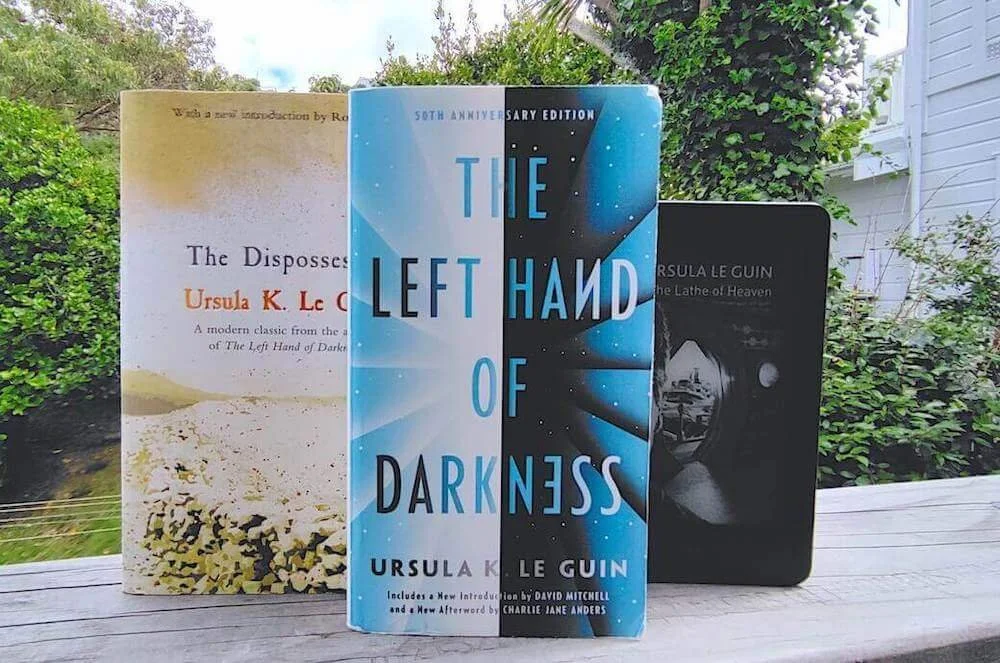
Le Guin’s most well-known works include her fantasy series “The Earthsea Cycle,” a four-part series that follows the wizard Ged across the magical Earthsea archipelago, and her Hainish sci-fi novels, including “The Left Hand of Darkness,” a novel that imagines a world where gender is not binary; “The Dispossessed,” a novel about a society that has eliminated all forms of government and private property; and “The Lathe of Heaven,” a novel that explores how even the best intentions often have terrible unforeseen consequences. Below, I’ve rounded up the books I think are essential — across both her fantasy and her science fiction — with a note on where to start if you’re new to her work.
Throughout her career, Ursula K Le Guin received numerous awards and accolades, including multiple Hugo, Nebula, and Locus Awards. Her work continues to be celebrated for its creativity, intelligence, and thought-provoking themes.
Related: If you like science fiction check out Sunset In The East by Ben Luxon.
A Wizard of Earthsea by Ursula K. Le Guin

A Wizard of Earthsea is the book most readers meet Le Guin through, and for good reason. It follows Ged, a boy with a raw, untrained gift for magic, as he’s sent to the school on Roke to learn to master it — and, in a moment of pride and fear, unleashes a shadow-creature that hunts him across the archipelago for the rest of the book.
What struck me most reading it is how quiet the stakes feel compared to most fantasy of its scale. There’s no dark lord, no war for the fate of the world — just a boy learning that power without self-knowledge is dangerous, and that the thing chasing him is, in some sense, a part of himself he has to name and accept rather than defeat. Le Guin builds the magic system around the idea that everything has a true name, and knowing that name gives you power over it. It’s a simple idea that ends up carrying the whole book’s theme: understanding yourself is the real magic.
It’s the first in the Earthsea Cycle, and while later books complicate and even push back against some of what this one sets up, A Wizard of Earthsea stands completely on its own as one of the best coming-of-age fantasy novels ever written.
For readers who’ve only known Le Guin as a sci-fi writer, this is the place to see the other half of what made her great.
The Left Hand of Darkness by Ursula K. Le Guin
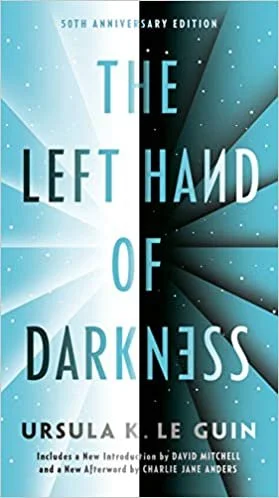
The Left Hand of Darkness is set in a world called Gethen. The inhabitants are entirely genderless for most of the month, but for a period of about four to five days they become either male or female. With this biological setup, Le Guin sets out to answer the question: what if there was no gender? What if gender wasn’t binary?
Another book from the Hainish series, it follows the human envoy Genly Ai, who is sent to Gethen to encourage their integration into the Hainish confederation of planets. However, Genly Ai quickly finds himself out of his depth. He can’t understand the complex idea of Shifgrethor — a genderless replacement for the idea of male pride — and he’s constantly imposing his own worldview on those around him, one that is inherently misogynistic and entirely alien. This prevents him from truly understanding the people of Gethen and leads him into trouble on more than one occasion.
The novel also delves into the political landscape of Gethen, exploring power dynamics between different nations — one being a socialist dictatorship reminiscent of the Nazi SS, the other a monarchy with a mad ruler.
The Left Hand of Darkness is a masterful science fiction novel. It explores the themes of gender, identity, and culture with intelligence and nuance, and is a classic that examines one of the fundamental dichotomies at the root of human culture.
You may also like the Best Books by China Miéville: Perdido Street Station and More
The Dispossessed by Ursula K. Le Guin
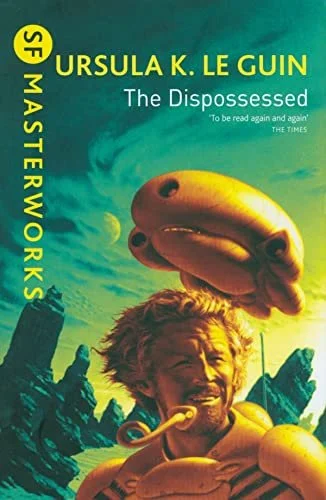
The Dispossessed is part of Le Guin’s Hainish series. In this novel, she asks: what if no one owned anything? What would society look like, and how would such a society engage with — and be viewed by — a more capitalistic one?
The story is set on the planet Urras, a capitalist society of warring nation-states, and its moon Anarres, a society based on anarchism and cooperative living. The protagonist is a physicist named Shevek, from Anarres — a once-in-a-millennium genius on the verge of realising a unified theory of time. However, in this communistic society, those who excel are looked down upon as trying to set themselves above the rest. Eventually, in order to receive the support he needs to complete his work, he travels to Urras.
Things, however, are never simple. The political landscape of Urras is convoluted, and Shevek finds himself being used by the very people who claim to be his friends. By having Shevek travel between the two worlds, Le Guin sets up an incredible juxtaposition — we see the good and the bad of both societies starkly contrasted side by side. Greed and individualistic selfishness on one side, narrow-minded tribalism on the other.
The Dispossessed is a thought-provoking and deeply philosophical novel. One of the things I loved most about it is the richness of the world-building. Le Guin asks a powerful question and takes it to a logical extreme. There’s no realised Utopia and no terrible Dystopia — instead, both worlds and societies have pitfalls that occur organically, because it’s human nature.
For lovers of sci-fi looking for their next read, The Dispossessed is a must.
The Word for World Is Forest by Ursula K. Le Guin

Another Hainish novel, and one that’s aged into something close to essential reading. The Word for World Is Forest is set on the forest planet of Athshe, where a human logging colony has enslaved the native Athsheans to strip the planet’s timber for a resource-starved Earth. It’s Le Guin at her most furious — written, by her own account, out of anger at the Vietnam War — and it doesn’t soften that anger for the reader.
The Athsheans are a deeply pacifist people, and the novel’s real subject is what happens when a culture that has never needed violence is forced to learn it in order to survive. Le Guin doesn’t present that as a triumph. Watching the Athsheans discover war is genuinely painful, and the book refuses to let colonisation, or resistance to it, feel clean.
It’s shorter and angrier than The Dispossessed or The Left Hand of Darkness, and it’s the one I’d recommend to anyone who thinks Le Guin’s reputation for gentleness means her books don’t have teeth.
The Lathe of Heaven by Ursula K. Le Guin
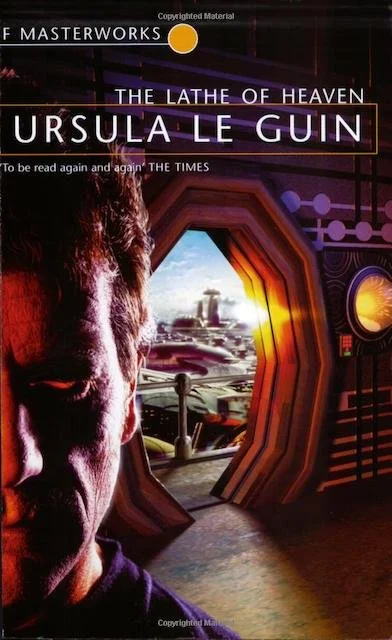
The Lathe of Heaven, first published in 1971, follows George Orr, a man who has the ability to change reality through his dreams. When George is referred to a psychiatrist named William Haber, Haber realises the power of George’s dreams and begins to manipulate them in order to change the world according to his own utopian vision.
This story leans heavily on Taoism and Stoicism. But where stoics know they can’t control the shape of the world around them, and Taoists know they shouldn’t (but rather be flexible, like water), this story explores what would happen if you could assert your desires onto the world. Far from the utopian vision, each time Haber alters reality — despite his best intentions — unintended consequences arise, leading to a cycle of dystopian destruction.
It’s one of those books you finish and wish you could read for the first time again. Shocking, thought-provoking, and phenomenally executed — this is Ursula K Le Guin at her best.
Readers interested in morally complex characters may also be interested in our article 9 Grimdark Fantasy Books for Fans of Gritty Fiction.
The Ones Who Walk Away from Omelas by Ursula K. Le Guin
Technically a short story rather than a novel, but no list of Le Guin’s essential work is complete without it — and at under ten pages, there’s no excuse not to read it. The Ones Who Walk Away from Omelas describes a utopian city, Omelas, whose perfect happiness depends entirely on the perpetual suffering of a single locked-away child. Every citizen learns of the child’s existence as they come of age. Most stay anyway. A few walk away, and the story never tells us where they go.
It’s less a story than a thought experiment dressed in narrative clothes, and that’s exactly the point. Le Guin isn’t interested in plot here — she’s interested in making you sit with the question of what you’d do, and whether “I would walk away” is actually as easy or as meaningful an answer as it sounds.
I hand this one to people who say they don’t have time to get into Le Guin’s novels. It takes fifteen minutes and does more moral heavy lifting than most books ten times its length.
Where to Start: The Works of Ursula K Le Guin
Ursula K Le Guin has quickly become one of my favourite authors of all time. Her work places her with the greats of speculative fiction — Arthur C Clarke, Isaac Asimov, Philip K Dick, and Tolkien among them, depending on which side of her writing you’re approaching from. But with so many great novels to choose from, where should you start?
It depends on what you want. If you want a fantasy novel — a charming, deceptively simple read that will remind you why you fell in love with reading — start with A Wizard of Earthsea. If you’re looking for something shorter but still packed full of powerful ideas, try The Lathe of Heaven, or better yet, The Ones Who Walk Away from Omelas if you want something you can finish on a lunch break.
If you’re a hardcore sci-fi fan ready to dive deep into her Hainish series, there’s no particular reading order as each is an independent standalone novel. My recommendation would be The Dispossessed.
Ursula K Le Guin’s Hainish Novels Reading Order
Hainish Series Publication Order
Whilst Le Guin never intended the Hainish series to be read as a series or cycle, the logical way to read them is either in publication or chronological order.
- Rocannon’s World (1966)
- Planet Of Exile (1966)
- City Of Illusions (1967)
- The Left Hand Of Darkness (1969)
- The Word For World Is Forest (1972)
- The Dispossessed (1974)
Hainish Series Chronological Order
I say ‘sort of’ because Le Guin never intended the books to be thought of as a series. So while a chronological order emerges, it’s not particularly clear-cut.
- The Dispossessed (c.2300 AD)
- The Word for World Is Forest (c.2368 AD)
- Rocannon’s World (c.2684 AD)
- Planet of Exile (c.3755 AD)
- City of Illusions (c.4370 AD)
- The Left Hand of Darkness (c.4670 AD)
Earthsea Reading Order
Unlike the Hainish novels, the Earthsea books are best read in publication order — later books directly build on and complicate earlier ones.
- A Wizard of Earthsea (1968)
- The Tombs of Atuan (1971)
- The Farthest Shore (1972)
- Tehanu (1990)
- Tales from Earthsea (2001)
- The Other Wind (2001)
FAQ
What is Ursula K. Le Guin’s most famous book?
It depends who you ask. Within science fiction circles, The Left Hand of Darkness is usually considered her defining work — it won both the Hugo and Nebula Awards and is regularly cited as one of the most important SF novels of the 20th century. Among general readers, A Wizard of Earthsea is probably better known, especially outside the US.
Where should I start reading Ursula K. Le Guin?
If you want fantasy, start with A Wizard of Earthsea. If you want science fiction, start with The Dispossessed or The Left Hand of Darkness. If you just want to know whether her writing is for you before committing to a full novel, read the short story The Ones Who Walk Away from Omelas first — it takes about fifteen minutes.
Is Earthsea fantasy or science fiction?
Earthsea is fantasy. Le Guin is unusual among major genre authors in having written landmark work in both fantasy (Earthsea) and science fiction (the Hainish Cycle), which is part of why “best Ursula Le Guin books” lists tend to pull from both.
How many books did Ursula K. Le Guin write?
Le Guin published more than twenty novels, along with numerous short story collections, poetry, essays, and children’s books, across a career spanning from the 1960s until her death in 2018.
You Might Like
- The 10 Best Isaac Asimov Books To Read Today
- 12 Classic Science Fiction Short Stories You Need To Read
- 9 Dystopian Novels That Will Change How You View The World
- 10 of the Best Science Fiction Authors That Everyone Should Read
- 29 Best Fantasy Books
If you like science fiction learn more about Sunset In The East by Ben Luxon.

Love books? You'll love Litloop.
Track your reading, send personal recs, and have real conversations about the books you love.
Create free accountFree forever · Beta now live · iOS & Android apps coming soon