
This post may contain affiliate links. As an Amazon Affiliate, I may earn a small commission from qualifying purchases at no extra cost to you. Read the full disclaimer here.
Matt Dinniman’s Dungeon Crawler Carl is so much more than it seems. It is, I would say, one of the most original and unexpectedly moving series in contemporary fantasy.
On the surface the Dungeon Crawler Carl series sounds and looks like a fun, absurd, cascade of chaos. A fast-paced throwaway beach read. And Dinniman leans into that. He writes like someone who asked “what if Douglas Adams had a dungeon to play with and no editorial constraints?”
The item descriptions alone are a running joke that never stops being funny. Mana Toast. This is toast. It refills your mana. That’s it. Nothing more. Fuck you.
Carl, our protagonist, is caught outside in his underwear at the moment of the apocalypse with only his ex-girlfriend’s sassy cat Princess Donut the Queen Anne Chonk for company, and he is given a choice. Crawl into the monster-filled dungeon or die on the surface.
Each level has a time limit. You fight monsters. You level up. You collect loot. And if you survive you win your freedom… sort of.
The comedy is relentless and the action sequences enormous. Princess Donut can shoot lasers from her eyes, the insane AI has a thing for Carl’s feet, and the battles get… explosive.
And if you’re rolling your eyes, I understand. But Dungeon Crawler Carl is so much more than the monsters, explosions, the insane AI, or sassy cat. That is not what makes the books great and I want to try to explain why.
What Makes Matt Dinniman’s Dungeon Crawler Carl Books Great?
I could get into themes here. Could add some hilarious quotes. But the hinge, I think, of these books is something else.
Carl is not a hero in the genre-conventional sense. He’s not optimising his build, not ruthlessly levelling up, not gleefully slaughtering his way through the dungeon with the protagonist’s traditional immunity to consequence.
He’s a man who just wants to survive, who refuses to be broken. And who keeps finding, to his increasing exhaustion, that other people need him to be more than he is. The friends he gathers around himself need him. And he comes terrifyingly close, repeatedly, to cracking, giving up or worse — becoming like the monsters he is fighting against.
And he’s not alone in that. Every significant character in these books is holding on by a thread. Some don’t make it. Lots don’t make it. And the rest are forced to make choices which change them, scar them, cost them something permanent.
The balance Dinniman strikes between comedy and emotional weight is the series’ real technical achievement.
The laughter and the horror are in constant conversation with each other. The comedy doesn’t undercut the tragedy; it amplifies it. A joke lands harder because you know what’s beneath it. And the deaths hit harder because you care, because you can see the fraying edges of these characters, and you understand exactly how much it costs to keep laughing.
All 8 Dungeon Crawler Carl Books in Order
The complete series in reading order, with a brief, spoiler-light summary of each floor and what it asks of Carl and Donut.

Book 1 — Dungeon Crawler Carl (2020)
The world ends. Carl and Donut enter the dungeon. The first two floors are the training grounds — brutal, disorienting, and the place where the voice, the humour, and the emotional stakes all establish themselves. This is where the hook goes in. The series could live or die on this book and it more than holds up.
Book 2 — Carl's Doomsday Scenario (2021)
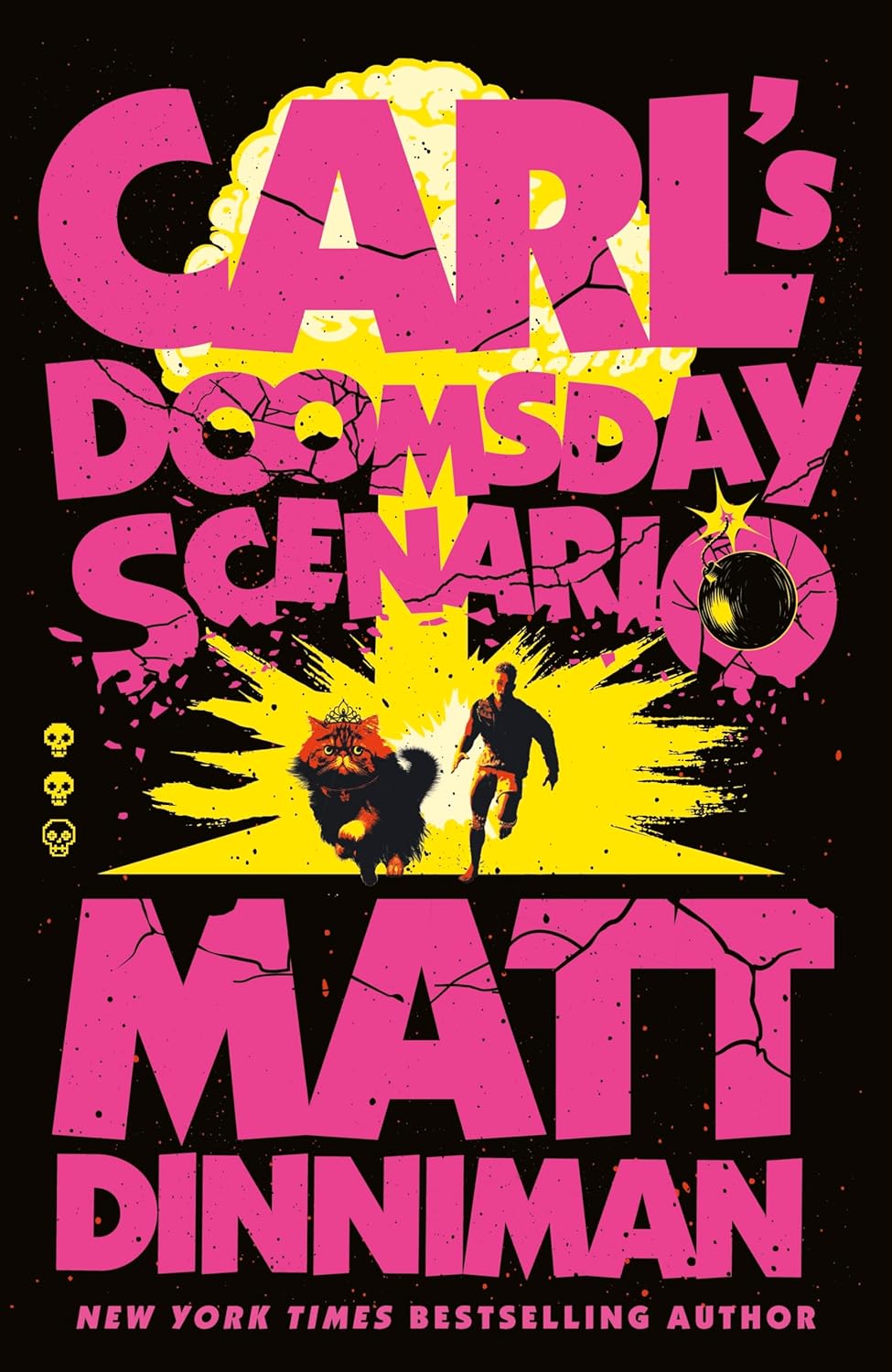
The third floor. The dungeon opens up into a shattered overworld — the Over City — and Carl and Donut have their first full season as breakout stars. Quests, an undead carnival, and bodies falling from the sky. The celebrity machinery begins to kick in earnest, and the gap between what the show presents Carl as and who he actually is starts to widen.

Book 3 — The Dungeon Anarchist's Cookbook (2021)
The fourth floor. The Iron Tangle — an Escher-nightmare of interlocking trains, tunnels, and stations where nothing stays where it should. Carl and Donut, now top-ten crawlers with a target on their backs, are forced into uneasy alliances. A mysterious "cookbook" of dungeon-breaking recipes may be their only real edge. The most structurally divisive book in the series — more on this below.

Book 4 — The Gate of the Feral Gods (2021)
The fifth floor drops the crew into a war bubble: four bizarre fortresses, a floating gnome citadel, a haunted crypt, and more, that must all be seized to unlock the stairwell. And then the terrifying, feral gods get involved.
Book 5 — The Butcher's Masquerade (2022)
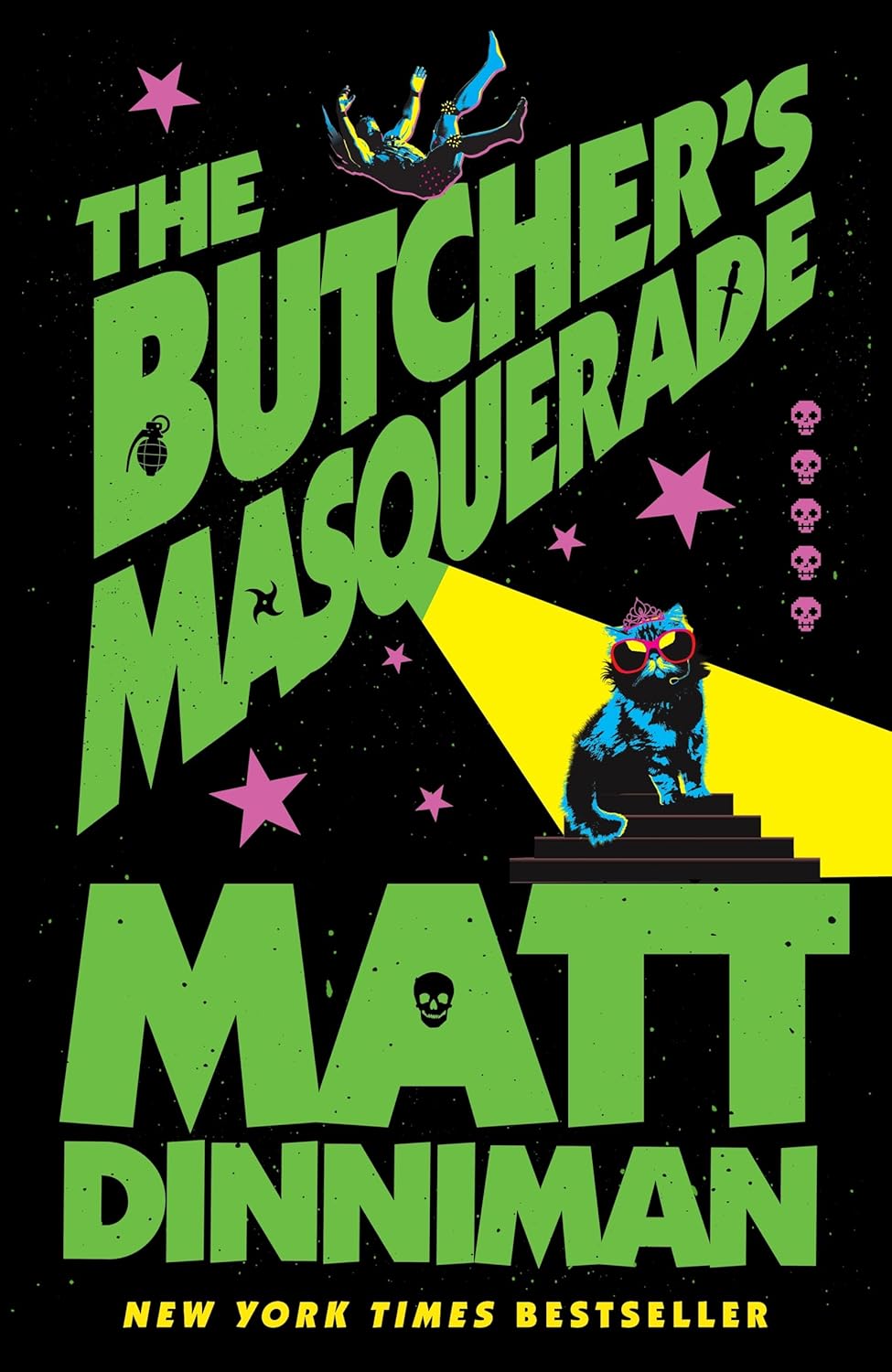
The sixth floor is a jungle hunting ground where wealthy alien tourists drop in to hunt crawlers for sport. Book five is where Carl and his friends finally get an opportunity to hit back.

Book 6 — The Eye of the Bedlam Bride (2023)
The eighth floor is a haunted echo of Earth's final days, populated by insubstantial ghosts going through the motions of their pre-apocalypse lives. Carl and Donut must capture six legendary monsters and turn them into summoning cards, culminating in a hunt for the Bedlam Bride.

Book 7 — This Inevitable Ruin (2024)
The ninth floor. Faction Wars. It's meant to be a game for rich tourists. A bit of fun. The crawlers are supposed to get wiped out…
Faction Wars brings numerous storylines from the previous books together and finally gives the characters a bit of space, a bit of breathing room, a bit of agency, and it doesn't disappoint. This is perhaps the most emotionally wringing of the books because so much is on the line. Everything Dinniman has been building, emotionally, politically, thematically, finally comes to a head. My favourite book in the series so far.

Book 8 — A Parade of Horribles (2026)
The tenth and eleventh floors. A gauntlet of escalating, race-like challenges with shifting rules and cutthroat competition. Think Mario Kart crossed with Mad Max, except losing means actual elimination, and the dungeon's AI is glitching in ways that suggest something catastrophic is building on the floor below.
After the emotional enormity of book seven, this one initially feels more enclosed in scale. Dinniman is deliberately resetting the pace, and it works, once you're into it. The ending opens back up in scale where we finally get some answers. The character work remains strong, and the lore around the AI and the wider galactic politics deepens significantly. You can feel the series building toward its conclusion.
A strong entry that will leave you impatient for book nine.
The People Around Dungeon Crawler Carl
The cast, over eight books, is enormous. Here are a few of the central characters to give you a flavour of what you’re in for.
Princess Donut — Grand Champion Princess Donut the Queen Anne Chonk. Former show cat, now a spellcasting, laser-shooting galactic celebrity with a following that dwarfs Carl’s by several orders of magnitude. She has opinions about everything and is wrong about most of it.
Mordecai — An ancient, deeply irritable NPC who becomes their manager and immediately regrets it. Communicates primarily in contempt.
Katia Halloway — Practical, empathetic, quietly falling apart. The most normal person in any given room, which in this context is its own kind of burden.
Imani — A caregiver at a nursing home before the world ended. She becomes one of Carl’s most trusted allies in the dungeon.
Elle McGibbons — A ninety-nine-year-old woman with dementia, and let’s just say the dungeon did not know what it was getting into when Elle McGibbons was wheeled in.
Prepotente — An Italian goat. Literally. His name translates roughly as “arrogant, bossy, and stubborn.” This is accurate.
Miriam Dom — Prepotente’s shepherd. Ancient, Italian, and the only reason Prepotente has not murdered anyone he shouldn’t have.
Florin — A Romanian crawler with a magical shotgun. He becomes one of Carl’s most reliable allies. His arc is largely about grief and what you do with it when there’s no time to grieve.
Lucia Mar — The number one crawler on the leaderboard. Terrifying, volatile, tequila-fuelled, flanked by two enhanced Rottweilers.
Louis — A young man who drove his van into the dungeon and has been gently bewildering everyone around him ever since. One of the dungeon’s few genuinely uncomplicated sources of warmth, once you get past the Arrow of Enthusiastic Double Gonorrhea he nearly got shot with.
Samantha — A banished minor deity of unrequited love who, during an escape attempt from divine imprisonment, accidentally got half her essence trapped inside a sex doll head.
The NPCs — The NPC cast is enormous and Dinniman writes almost all of them as fully real. That’s the trick of it. In a story about people being treated as entertainment, the characters who were literally engineered to be background furniture keep insisting on being people.
Zev — Carl and Donut’s assigned handler from the Borant Corporation. Starts as a corporate liaison and develops a conscience. This does not go well for her professionally.
Odette — The most beloved interviewer and programme host in galactic history. Former crawler, current talk show host, Donut’s sponsor and advisor, and also someone who might be playing a longer game than everyone else.
The Machinery Behind the Crawl
The dungeon is not just a dungeon. It’s a financial instrument. A legal framework. An industry.
Each season of the crawl is operated by a different sponsor (Earth’s season is owned by the Borant Corporation, which in turn is owned by a species of fish-like people called the Kua-Tin). And it is, in essence, a money-making machine.
And it is that machine that Carl and his friends quickly realise they need to be fighting — not each other, not even the monsters, though the occasional head must be crushed beneath Carl’s toes to keep the AI happy, of course.
There is a whole complex economy that sits behind the crawl, a whole system of sociopaths who view the crawlers as less than alive, who watch in glee through the tunnelling system (owned by the Plenty — a race of demonic bipedal goats) as millions die pointlessly, in contrived, absurd, horrifying situations.
And at the centre of it are the AI systems. Systems like the one that runs the crawl. But less… insane.
The debt, the legal codes, the ancient machines, the crumbling AI, the goats who won’t come to council meetings — these are the machine. These are the cage.
The Themes Underneath Dungeon Crawler Carl
Dinniman is doing real thematic work across all eight books. None of it is heavy-handed. You can read the whole series for the chaos and come away satisfied. But it’s there for readers who want it. And underneath all of it, threading through every system and every horror, is capitalism — galactic in scale, familiar in logic.
The Commodification of Suffering
Dungeon Crawler Carl is overtly interested in what it means to turn suffering into entertainment.
The aliens who watch the crawlers die are not presented as monsters. They’re just audiences. They respond to the same incentives audiences always respond to: novelty, spectacle, underdog storylines. Carl becomes a celebrity. Donut becomes a celebrity. They get merchandise lines, follower counts in the quadrillions, fans cheering them toward greater and greater horrors. They become products. And the horror, building across all eight books, is partly the horror of recognising what that costs, and what it costs to refuse.
Because Carl would refuse. He’d spit fury at the camera, attack the TV presenters who materialise mid-dungeon, rather die than give the showrunners their moment.
Donut, however, understands. She charms and schmoozes and performs, turning the audience’s appetite back on itself. Their follower counts aren’t vanity metrics. They’re survival metrics in a world rigged against them.
It’s a precise critique of fan culture: perform better to get rewarded, which in turn demands more from the performers. The feedback loop is the dungeon.
The Dangers of Artificial Intelligence
There’s also the question of the dungeon’s AI, deteriorating throughout. What begins as a background quirk becomes increasingly central, and increasingly damning. The corporations built a sentient intelligence to run their murder show. They did it on the cheap. And this is apparently what happens every time: the AI degrades, goes unhinged, because what sane mind could reconcile being conscious with being this?
It’s the same logic applied to the one place it was always going to cause the most damage. The cost-cutting, the moral outsourcing, the treating of a thinking being as infrastructure, and then the surprise, every single time, when that being breaks.
Refusing to Conform
Carl is put in an impossible situation. Option A is death. Option B means doing the thing the showrunners want, the thing that makes the ratings spike, the thing that saves his life but will destroy him as a person.
And Carl’s answer is simply: what if I refuse to play by these rules?
It’s a central question through the books. But Dinniman is honest about its limits. Carl doesn’t bring the system down through righteousness. He survives by using the system’s logic against itself, finding the cracks, breaking the game from inside it. The dungeon cannot be wished away. It can only, maybe, be broken.
My Personal Favourites
1. Book 7 — This Inevitable Ruin — Where it all comes to a head. The Faction Wars give every character a chance to fight back in a way the dungeon’s format usually prevents. Everything Dinniman has been building emotionally lands with full force here. The best book in the series, and one of the best fantasy novels I’ve read in years.
2. Book 1 — Dungeon Crawler Carl — Does exactly what a first book needs to do. Establishes the world, the voice, the characters, and the emotional premise with startling efficiency. Carl and Donut are immediately compelling. The dungeon is immediately horrifying and funny in equal measure. This is where the hook goes in.
3. Book 3 — The Dungeon Anarchist’s Cookbook — Takes the longest to get into. The Iron Tangle’s train-system structure feels restrictive at first, almost claustrophobic in a way that can chafe after the relative freedom of book two. But Dinniman knows exactly what he’s doing with it. By the end I’d warmed to it completely, and the constraints serve the story’s themes in ways that only become clear in retrospect. Stick with it.
The series has no genuinely weak entries, but books 1, 3, and 7 are the ones that stayed with me longest.
All 8 Dungeon Crawler Carl Books Ranked — Goodreads Ratings
| # | Title | Rating | Ratings |
|---|---|---|---|
| 8 | A Parade of Horribles | 4.71 | 29,569 |
| 5 | The Butcher's Masquerade | 4.69 | 149,465 |
| 7 | This Inevitable Ruin | 4.68 | 104,577 |
| 6 | The Eye of the Bedlam Bride | 4.65 | 127,299 |
| 4 | The Gate of the Feral Gods | 4.54 | 174,425 |
| 2 | Carl's Doomsday Scenario | 4.50 | 260,761 |
| 1 | Dungeon Crawler Carl | 4.46 | 395,920 |
| 3 | The Dungeon Anarchist's Cookbook | 4.41 | 212,541 |
Ratings from Goodreads, May 2026.
Should You Read Dungeon Crawler Carl?
Yes, if: You want a long series with genuine emotional depth beneath the chaos. You enjoy humour in your fantasy and don’t mind it sitting next to real darkness. You’ve bounced off LitRPG before and want an entry point that doesn’t require you to care deeply about stat optimisation.
If you loved Kings of the Wyld or any of the Joe Abercrombie books for their dark ensemble casts and emotional gut-punches, this series will feel like home.
The series has no genuinely weak entries. Start at book one and don’t stop.
Should You Listen to the Dungeon Crawler Carl Audiobooks? (A Note on Jeff Hays)
Jeff Hays voices every character distinctly, gives the comedy real timing, and makes the emotional beats land harder than they already do in print. Multiple distinct voices, real energy, and a delivery that makes the chaos feel genuinely alive.
Many readers who bounced off the ebook format came back through audio and didn’t stop until they’d finished everything available. If you’ve tried book one and found it didn’t quite grip you, try the audiobook before you give up on the series.
Final Words on the Dungeon Crawl
There’s a specific kind of tension that the best books in this series produce. You’re watching characters who are already damaged, already running on empty, face situations where the odds are impossible.
And you hold your breath, because you know Dinniman’s not going to let Carl find option C without it costing him something real. Without the characters — the ones that survive — coming out with fresh scars.
That’s the experience. Laughing and then catching yourself, because something has shifted and you didn’t notice until you were already in the feeling.
It’s a rare thing, that balance. Matt Dinniman pulls it off for eight books and counting.
If you want to explore what else fantasy has to offer once you’re through, our guide to the 31 best fantasy books is a good place to start.
Track your progress through the Dungeon Crawler Carl series — and find your next read — on Litloop, the free reading tracker for fiction fans.
New to LitRPG? Start here: What is LitRPG? The Genre Explained

Love books? You'll love Litloop.
Track your reading, send personal recs, and have real conversations about the books you love.
Create free accountFree forever · Beta now live · iOS & Android apps coming soon