If you read a lot, you need a book tracking app. Not because anyone is marking your homework, but because by November you can’t remember whether you read that grimdark trilogy in March or June, and you’d quite like to know how close you are to your yearly goal.
A good book tracker does three jobs. It logs what you’ve read and what’s on your TBR, it shows your progress, and it makes books more fun rather than more like admin. The best ones also tell you what your friends are reading, which is still the most reliable way I know to find a new favourite.
There are plenty of options now, and they’ve all got a different personality. Here are my top five, who each one suits, and where each falls short.
Full disclosure: I built Litloop, so it’s at number one and you should weigh that accordingly. I’ve tried to be straight about its weak spots too, and I use the other four on this list for comparison.
Quick Comparison: The Best Reading Trackers at a Glance
| App | Best for | Price | Standout feature |
|---|---|---|---|
| Litloop | Friends, goals and honest reactions | Free | Social tracking without the leaderboard |
| StoryGraph | Stats and mood-based picks | Free, Plus $4.99/mo | Reading graphs and quarter-star ratings |
| Hardcover | A free, modern Goodreads replacement | Free | Clean design, easy imports |
| Fable | Online book clubs | Free, Plus $5.99/mo | Club chat rooms and streaks |
| Goodreads | The biggest catalogue and community | Free | Sheer size of the user base |
The 5 Best Book Tracking Apps
1. Litloop
Best for: readers who want to log books, hit a yearly goal and swap honest opinions with friends.
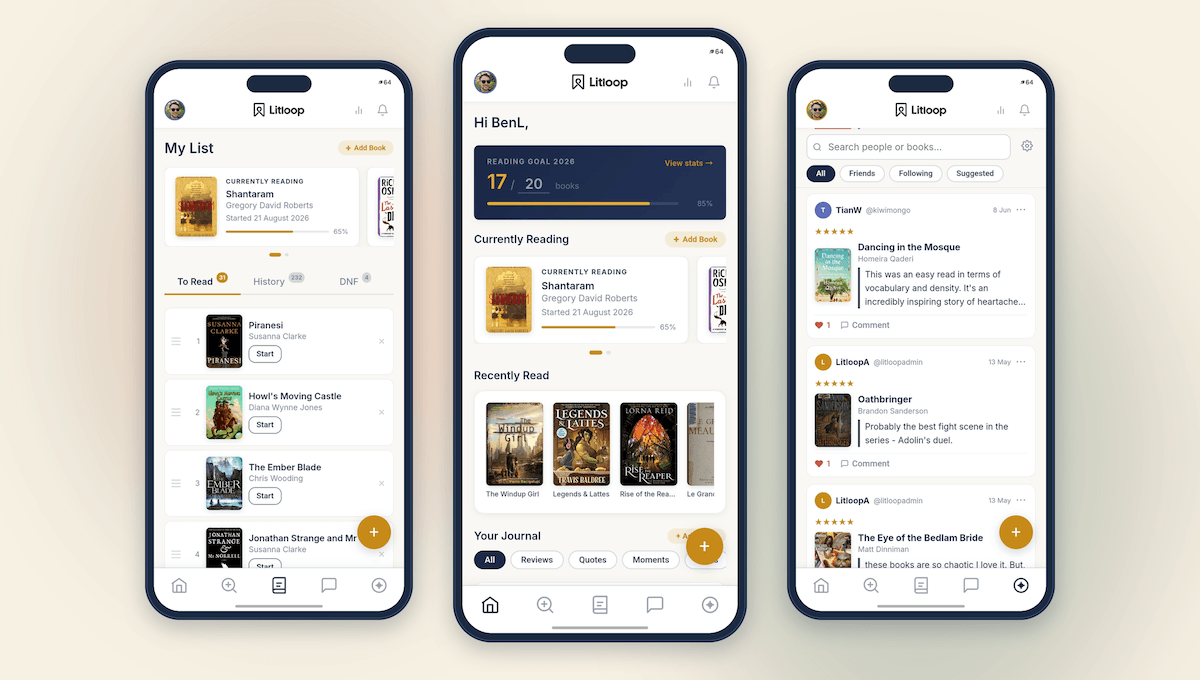
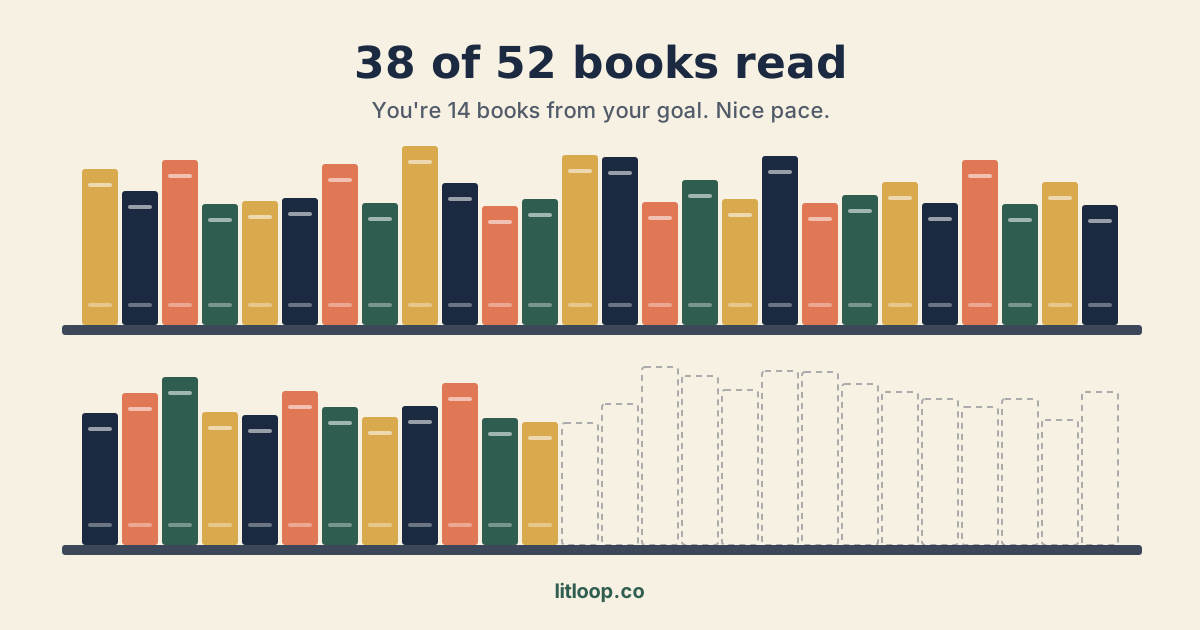
Litloop is a free reading tracker built around one idea: the best recommendations come from people you trust, not a recommendation engine guessing at you. You log what you’re reading, track your progress and yearly goal, and see what your friends are finishing and what they actually thought.
The tone is deliberately gentle. There’s no leaderboard and no guilt-tripping. If three friends finished a book this month, you’ll see it. If you’re four books from your goal, you’ll get a nudge, not a scolding.
A few things I’d point to:
- Friend-first feed. You see reactions from people you follow, so a rating comes with a person attached.
- Spaces and book clubs. Book-by-book discussion spaces, handy if your reading group has outgrown the group chat. (If you’re starting one, our guide to how to start a book club is a good place to begin.)
- Genre hubs. Top 100 lists for fantasy, sci-fi, crime and mystery and more, so you can browse without leaving the app.
- AI Picks. Suggestions based on what you’ve read, for the days nobody in your friend list has an answer.
The catch: Litloop is newer, so the community is smaller than Goodreads or StoryGraph. The social side gets better the more of your friends are on it. If you read mostly alone and want deep charts, StoryGraph will suit you better.
See everything it does on the Litloop features page, or compare directly in our Litloop vs Goodreads and Litloop vs StoryGraph breakdowns.
2. The StoryGraph
Best for: data lovers and mood readers.
StoryGraph is the app most people mean when they say they’ve “left Goodreads”, and it passed 5 million users in January 2026. It’s built around stats. You get graphs of your genres, moods, page counts and pace, and you can answer questions like “what do I read when I’m in a slump?” with an actual chart.
Its mood and pace filters are genuinely useful when you know you want something fast, dark and plot-driven but can’t name a title. It also supports quarter-star ratings, which sounds like a gimmick until you’ve tried to choose between a 3 and a 4 for a book that was a solid 3.75.
The core app is free. StoryGraph Plus costs $4.99 a month or $49.99 a year and adds deeper stats and filters.
The catch: the social side is thinner than the rest of the app. As of 2026 you can like reviews but not comment on them, so conversation with friends mostly happens elsewhere.
3. Hardcover
Best for: anyone who wants Goodreads, but modern and free.
Hardcover is the closest thing to a straight Goodreads replacement that doesn’t feel like one. It’s an indie app with a clean design, and the core features are all free, including tracking, lists and the community side. There’s an optional Supporter plan if you want to back its development.
Moving over is painless. It imports from Goodreads and StoryGraph, plus a custom CSV, which matters if you’ve got years of reading history you don’t want to retype. It also has a Discord integration, a nice touch for readers whose communities already live there.
The catch: a small team means a smaller catalogue and a smaller user base than the big names, and its stats are lighter than StoryGraph’s.
4. Fable
Best for: book clubs, buddy reads and BookTok-adjacent readers.
Fable started life as a book club app and grew into a full reading tracker. Clubs are the heart of it. Each one has spoiler-safe chapter discussion rooms, so you can chat about chapter 12 without ruining chapter 30 for anyone. Add in reading streaks, monthly Reading Wraps and a yearly recap, and it’s very good at keeping you motivated.
Fable was acquired by Scribd’s Everand in June 2025, and the two now share a subscription. The app is free to use, and Fable Plus costs $5.99 a month or $49.99 a year.
The catch: if you only want to log books and count them up, it can feel like a lot of app. And because it’s so club-centred, it’s best if you actually want a club.
5. Goodreads
Best for: the biggest catalogue and the biggest crowd.
Goodreads is still where most readers start. It’s free, it has by far the largest catalogue, and almost every book you can think of has reviews. If you want to see what thousands of strangers thought of an obscure 1980s paperback, nothing else comes close.
It’s also showing its age. Ratings are whole stars only, stats are basic, and readers regularly complain about glitches with the Reading Challenge. For a tracker, it does the minimum. For social features, it’s Amazon-owned and rarely changes.
I’d keep a Goodreads account for browsing reviews even if you track somewhere else. It’s a handy reference library, even if it’s no longer the best place to log your reading.
How to Choose a Reading Tracker
Ask yourself what you’ll actually open the app for:
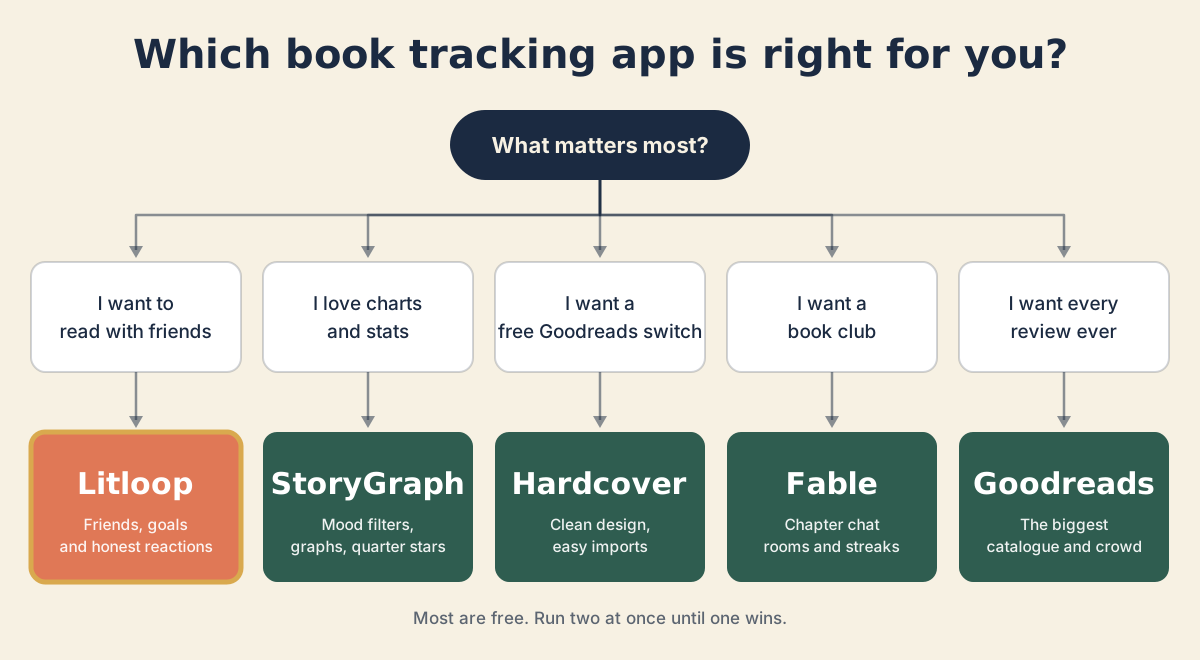
- Friends and honest opinions: Litloop.
- Charts and mood-based picks: StoryGraph.
- A free, Goodreads-style switch: Hardcover.
- Book clubs and buddy reads: Fable.
- Reviews of anything ever published: Goodreads.
Two practical tips. First, check the import before you commit. If you’ve got years of Goodreads history, a tracker that can bring it across will save you an evening. Second, don’t overthink it. Most of these are free, and you can run two at once until one wins.
If you’re short on ideas for what to log first, try our best fantasy series or best fantasy books you need to read today, or take the Litloop quiz to get a recommendation.
FAQ
What is the best book tracking app?
It depends what you want from it. StoryGraph is best for stats, Hardcover for a free modern Goodreads replacement, Fable for book clubs, and Litloop for tracking alongside friends. Most readers are happiest with the one their friends already use.
What is the best free book tracker?
All five apps here have a genuinely useful free version. Litloop, Hardcover and Goodreads are free to use, while StoryGraph and Fable keep a few extras behind paid plans.
Is there a book tracker with no ads or leaderboards?
Litloop is built around a loop of readers rather than a leaderboard, so there’s no ranking you against your friends. Hardcover is also free of the clutter you get with Goodreads.
Can I move my reading history from Goodreads?
Goodreads lets you export your library as a CSV from the desktop site. Hardcover and StoryGraph both import from it, so check any app’s import options before you switch.
Do I need a reading tracker at all?
No, a notebook works fine. But if you want yearly goals, stats, or to see what your friends are reading, a tracker does it for you in about ten seconds a book.
What’s the difference between a book tracking app and a reading tracker?
Nothing much. Both mean a place to log books, progress and goals. “Reading tracker” sometimes implies tracking time and pages, while “book tracker” leans towards your library and ratings, and most apps do both.
Ready to start? Join Litloop, the free reading tracker for fiction fans, and see what your friends are reading. Or browse the free apps to read books if you’re after somewhere to read as well as track.

Love books? You'll love Litloop.
Track your reading, send personal recs, and have real conversations about the books you love.
Create free accountFree forever · Beta now live · iOS & Android apps coming soon